

Entrance Exam Syllabus

ADMISSIONS 2026
Our Assessment Process
At The Apple International School, we aim to make our admission process as informative and smooth as possible. Our assessments are designed to identify the learning potential of each student, ensuring they are placed in an environment where they can thrive academically and socially.
Please note that for the 2026 academic year, child eligibility is calculated based on their age as of 31st December 2026.

Foundation Stage
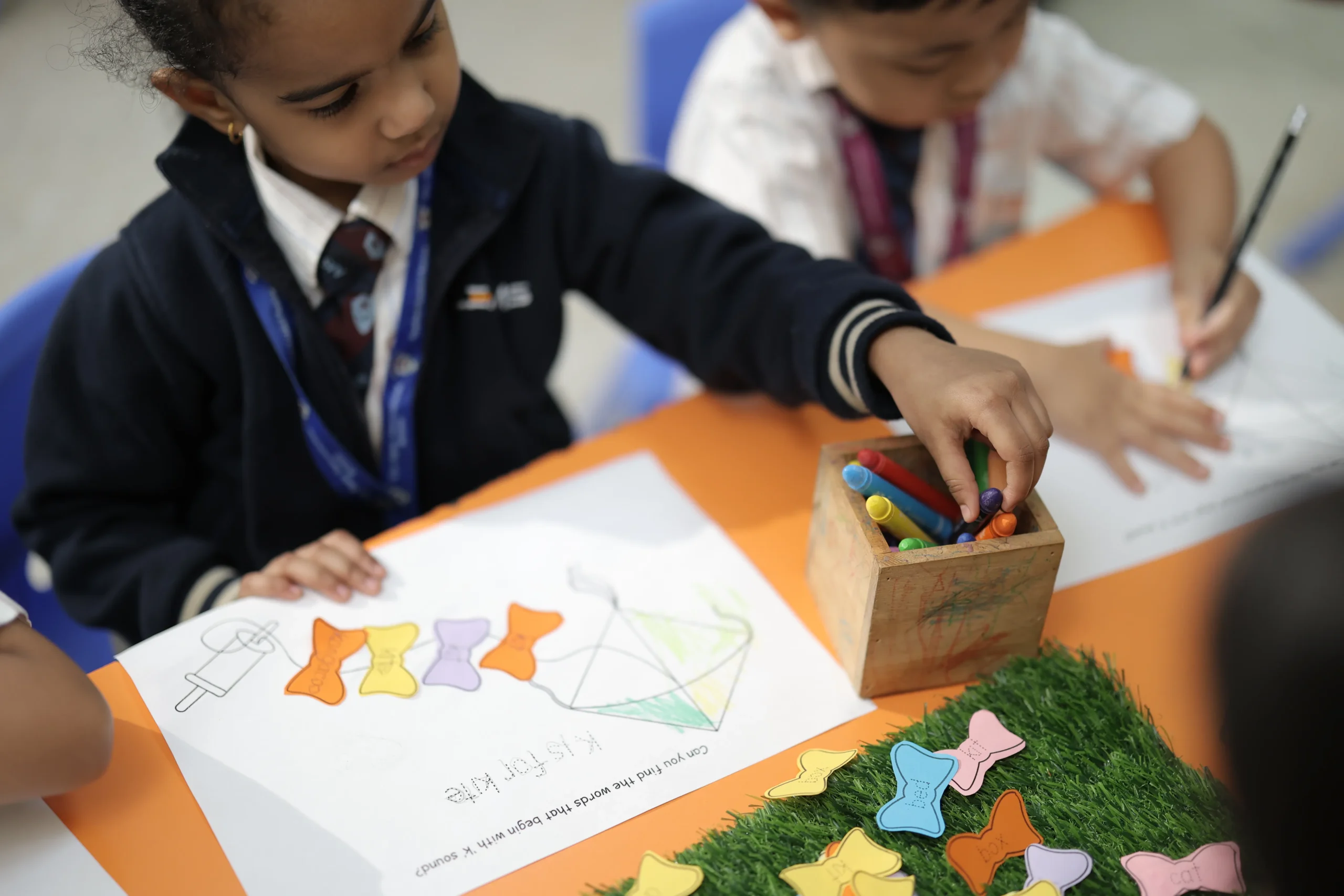
Interactive play-based session focusing on social cues and readiness.

Years 1 - 8
Evaluation of English and
Mathematics skills through
structured tasks.

Years 9 - 13
Core subject testing including
Science and CAT4 cognitive
abilities.

Year 12 (Sixth Form)
In-depth subject interviews
and previous IGCSE
performance review.
Foundation Stage (FS1 & FS2)
FS1 Eligibility
Child must be maximum 3 years old as on 31st December 2026 (KHDA guideline)
-
1
Stage 1:
Play-Based Group Observation — group activities, observation of social interaction, communication, cognitive/motor skills, behaviour
-
2
Stage 2:
Individual Interview (Parent & Child) — child's readiness + parents' interaction/partnership with school
-
3
Child must be toilet trained + able to follow simple instructions in English
FS2 Readiness
Child must be maximum 4 years old as on 31st December 2026
- Must've attended Nursery 6 months-1 year, OR completed FS1 in recognised school
- Fully toilet trained + independent personal hygiene
- Literacy: recognise/write uppercase-lowercase letters (Aa-Zz), correct pencil grip, letter sounds awareness
- Numeracy: number recognition, basic counting, quantity understanding
- Communication: simple English sentences (name, age), colours, animals/fruits/vegetables recognition, follow instructions
Required Documents (FS1 & FS2)
- Passport copies – child + both parents
- Residency visa pages – child + both parents
- Emirates ID (front & back) – child + both parents
- Child's Birth Certificate (English/Arabic)
- Recent passport-size photo of child
- Updated Vaccination Card
Preparing Your Child

Before the Day
Discuss the school visit as an exciting adventure. Ensure they have a good night’s sleep and a healthy breakfast.

Supporting Independence
Encourage simple tasks like tidy-up time and independent feeding to build classroom-ready confidence.

Settling In
The transition is key. Share positive stories about
school life to help reduce any first-day jitters.
Years 1 - 8 Assessment
Year 1 to Year 8 will have an Interactive interview session with the Section Heads, students, and parents and, if required, Inclusion Champion to determine the appropriate class.
- Interactive Group Activity
- Literacy & Numeracy Check
- Personal Interview
Detailed Syllabus (Years 9 - 13)
Core topics and examination criteria for senior secondary entry.
Reading, grammar and writing.
Reading, grammar and writing.
- Reading: Unseen Prose and Poem
- Grammar: Types of sentences (simple, complex and compound); Tenses
- Writing: Formal letter, Character description
Numbers, algebra, geometry and statistics.
Numbers, algebra, geometry and statistics.
- Numbers: Fractions, Percentage, Decimals, Prime Numbers
- Algebra: Simplifying and solving linear equations, Indices
- Geometry: Co-ordinate geometry, Circles, Properties of Angles, Shapes, and Angles
- Statistics: Mean, Median, Mode; Probability: Calculating Probability, Probability Scale
Respiration, properties of materials, and forces & energy.
Respiration, properties of materials, and forces & energy.
- 1) Respiration: The human respiratory system; Gas exchange; Breathing; Respiration
- 2) Properties of materials: Dissolving; Solutions and solubility; Planning a solubility investigation; Paper chromatography
- 3) Forces and energy: Forces and motion; Speed; Describing movement; Turning forces; Pressure between solids; Pressure in liquids and gases; Particles on the move
Comprehension, note-taking, email and review writing.
Comprehension, note-taking, email and review writing.
- Reading: comprehension, matching the text with information, taking notes
- Writing: Email writing and Review writing
Set texts for Year 10.
Set texts for Year 10.
- Report To Wordsworth
- Sonnet 18
- Where I Come From
- Prose: The Man who walked the moon
- Nick
Numbers, algebra, geometry and statistics.
Numbers, algebra, geometry and statistics.
- Numbers: Working with Fractions, Decimals, Significant figures, Order of Operations, Ratio and Proportions, Prime Numbers
- Algebra: Simplifying and solving linear equations, Expanding Brackets, Indices, Inequalities, Simplifying Algebraic Fractions
- Geometry: Pythagoras Theorem, Area, Properties of Angles, Shapes
- Statistics: Mean, Median, Mode; Handling Data: Sets Notations and Venn Diagram, Presenting Data
Density, heat, energy and electricity.
Density, heat, energy and electricity.
- Density, Heat and Temperature
- Conservation of Energy
- Moving from hot to cold
- Ways of transferring thermal energy
- Cooling by evaporation
- Electricity
- Electrical Circuits
Periodic table, reactivity and atomic structure.
Periodic table, reactivity and atomic structure.
- Periodic table
- Reactivity series
- Chemical equations
- Atomic Structure
Photosynthesis, carbon cycle and excretion.
Photosynthesis, carbon cycle and excretion.
- Photosynthesis
- More about photosynthesis
- The carbon cycle
- Climate change
- Excretion in humans
Comprehension, email and article writing.
Comprehension, email and article writing.
- Reading: comprehension, matching the text with information, taking notes
- Writing: Email writing and Article writing
Summary, descriptive and narrative writing.
Summary, descriptive and narrative writing.
- Reading: comprehension, Summary writing
- Writing: Descriptive or narrative writing
Set texts for Year 11.
Set texts for Year 11.
- A Midsummer Night’s dream
- Antony & Cleopatra
Numbers, algebra, geometry, statistics and probability.
Numbers, algebra, geometry, statistics and probability.
- Numbers: Prime Numbers, Working with Fractions, LCM and HCF, Percentage, Order of Operations
- Algebra: Simplifying and solving linear equations, Expanding Brackets, Indices, Simultaneous Equations, Inequalities
- Geometry: Area, Properties of Angles, Polygons, Shapes
- Statistics: Mean, Median, Mode; Handling Data: Scatter Graphs and Correlations, Stem and Leaf Diagram, Frequency Tables
- Probability: Calculating Probability
Motion & forces, thermal physics, and waves.
Motion & forces, thermal physics, and waves.
- 1. Motion, forces and energy: Physical quantities and measurement techniques; Motion; Forces; Effects of forces; Turning effect of forces; Centre of gravity; Energy, Work and Power; Energy resources; Pressure
- 2. Thermal Physics: Kinetic particle model of matter; Particle model; Gases and the absolute scale of temperature; Conduction; Convection; Radiation
- 3. Waves: General properties of waves; Light; Reflection of light; Refraction of light; Dispersion of light; Electromagnetic spectrum; Sound
States of matter, atomic structure and the periodic table.
States of matter, atomic structure and the periodic table.
- 1. State of Matter: Solids, liquids, and gases; Diffusion
- 2. Atoms, Elements and Compounds: Elements, compounds, and mixtures; Atomic structure and the periodic table; Isotopes; Ions and ionic bonds; Simple molecules and covalent bonds; Giant covalent structures; Metallic bonding
- 3. The Periodic Table: Arrangement of Elements; Group 1 Properties; Group VII Properties; Transition Elements; Noble Gas
Cells, biological molecules and human nutrition.
Cells, biological molecules and human nutrition.
- 1) Organisation of the organism: Cell structure; Size of specimens
- 2) Movement into and out of cells: Diffusion; Osmosis; Active transport
- 3) Biological molecules
- 4) Enzymes
- 5) Photosynthesis: Photosynthesis; Leaf structure
- 6) Human nutrition: Diet; Digestive system; Physical digestion; Chemical digestion; Absorption
Basic economic problems, demand, supply and elasticity.
Basic economic problems, demand, supply and elasticity.
- Basic economic problems
- Demand and Supply
- Production possibility curve
- Price elasticity
Bookkeeping through to financial statements.
Bookkeeping through to financial statements.
- Introduction to Accounting
- Double Entry Bookkeeping - Part A
- The Trial Balance
- Double Entry Bookkeeping - Part B
- Petty Cash Books
- Business Documents
- Books of Prime Entry
- Financial Statements - Part A
- Financial Statements - Part B
- Accounting Rules
- Other Payables and Other Receivables
- Depreciation and Disposal of Non-Current Assets
- Bad Debts and Provisions for Doubtful Debts
- Bank Reconciliation Statements
- Journal Entries and Correction of Errors
- Control Accounts
Business concepts, factors of production and growth.
Business concepts, factors of production and growth.
- Concept of business
- Factors of production
- Sectors and Types of business organizations
- Growth of business
- Mixed economy and Value Added
Theory, culture and social inequality.
Theory, culture and social inequality.
- Theory and methods
- Culture, identity and Socialization
- Social inequality
Mechanics, thermal physics, waves, electricity & nuclear physics.
Mechanics, thermal physics, waves, electricity & nuclear physics.
- 1. Motion, forces and energy: Physical quantities and measurement techniques; Motion; Forces; Energy, Work and Power; Pressure
- 2. Thermal Physics: Kinetic particle model of matter; Transfer of thermal energy; Thermal properties and temperature; Specific heat capacity; Melting, boiling and evaporation
- 3. Waves: General properties of waves; Light; Electromagnetic spectrum; Sound; Thin lenses
- 4. Electricity and Magnetism: Simple phenomena of magnetism; Electrical quantities; Electric circuits; Electromagnetic effects; Electromagnetic induction
- 5. Nuclear physics: The nuclear model of the atom; Radioactivity
States of matter through to metals and reactions.
States of matter through to metals and reactions.
- 1) States of matter: Solids, liquids and gases; Diffusion
- 2) Atoms, elements and compounds: Elements, compounds and mixtures; Atomic structure and the Periodic Table; Isotopes; Ions and ionic bonds; Simple molecules and covalent bonds; Giant covalent structures; Metallic bonding
- 3) The Periodic Table: Arrangement of elements; Group I properties; Group VII properties; Transition elements; Noble gases
- 4) Experimental techniques and chemical analysis: Experimental design; Chromatography; Separation and purification
- 5) Chemical energetics: Exothermic and endothermic reactions
- 6) Chemical reactions: Physical and chemical changes; Rate of reaction; Reversible reactions and equilibrium; Redox
- 7) Metals: Properties of metals; Uses of metals; Alloys and their properties; Reactivity series; Corrosion of metals; Extraction of metals
Classification, transport systems and human physiology.
Classification, transport systems and human physiology.
- 1) Characteristics and classification of living organisms: Dichotomous keys; Features of organisms
- 2) Organisation of the organism: Cell structure; Size of specimens
- 3) Movement into and out of cells: Diffusion; Osmosis; Active transport
- 4) Biological molecules
- 5) Enzymes
- 6) Photosynthesis: Photosynthesis; Leaf structure
- 7) Human nutrition: Diet; Digestive system
- 8) Transport in plants: Xylem and phloem; Transpiration; Translocation
- 9) Transport in animals: Circulatory systems; Heart; Blood vessels
- 10) Diseases and immunity
- 11) Gas exchange in humans
- 12) Respiration: Respiration; Aerobic respiration; Anaerobic respiration
- 13) Excretion in humans
Macroeconomic policy, trade and inflation.
Macroeconomic policy, trade and inflation.
- Govt: macroeconomic policies
- Elasticity of Demand and Supply
- Standard of living
- Balance of payments
- Exchange rate
- Inflation
- Employment and unemployment
- International trade
The accounting system through to incomplete records.
The accounting system through to incomplete records.
- Part I The accounting system: Double-entry bookkeeping (cash transactions); Double-entry bookkeeping (credit transactions); Books of prime entry; Balancing accounts; The classification of accounts and division of the ledger; The trial balance
- Part II Financial accounting: Income statements for sole traders; Statements of financial position for sole traders; Accounting principles or concepts; Accruals and prepayments (the matching concept); Provisions for the depreciation of non-current assets; Irrecoverable and doubtful debts; Bank reconciliation statements; Control accounts; Suspense accounts; Incomplete records
Costs, production and break-even analysis.
Costs, production and break-even analysis.
- Business costs
- Production methods
- Operations planning
- Economies of scale & Diseconomies of scale
- Break even analysis
Development, memory, perception and psychological problems.
Development, memory, perception and psychological problems.
- Development (Section A)
- Memory (Section B)
- Psychological problems (Section C)
- Perception (Section D)
Directed writing, comparison and text analysis.
Directed writing, comparison and text analysis.
- Directed writing
- Comparative response
- Text Analysis
Numbers, algebra, geometry, statistics and probability.
Numbers, algebra, geometry, statistics and probability.
- Numbers: Arithmetic Sequence, Simplifying arithmetic expressions, Sets, Ratio, Percentages
- Algebra: Simplifying and solving linear equations, Indices, Quadratic Equations, Graphing linear and quadratic equations, inequalities, and their graphs
- Geometry: Co-ordinate geometry, Circles, Properties of Angles, Transformations, Symmetry, Bearing, Trigonometry, Mensuration
- Statistics: Mean, Median, Mode, Charts
- Probability: Calculating probabilities of Independent and dependent, Types of events, Tree diagram
Analysis and child language acquisition.
Analysis and child language acquisition.
- Analysis
- Child Language Acquisition
Algebra, graphs, trigonometry, differentiation and integration.
Algebra, graphs, trigonometry, differentiation and integration.
- Algebraic expressions
- Quadratics
- Equations and Inequalities
- Graphs and Transformations
- Straight line graphs
- Trigonometric Ratios
- Radians
- Differentiation
- Integration
